Ten Questions About GLP-1s, Answered in the Right Order
Ask “which GLP-1 is strongest” and you’ll get six different answers depending on who’s selling what. Ask a sharper set of questions, in order, and the noise mostly falls away. Here they are, one at a time.
1. What is everyone actually arguing about?
Two separate things, usually mashed into one. First: which molecule, at which dose, produced the biggest number in a trial. Second: which provider hands you that option without stretching what the trial actually proved. Those are different scorecards. This piece keeps them separate, because collapsing them is how marketing gets in.
One thing to settle before any of it: these are prescription drugs. The person weighing risk and benefit is supposed to be the clinician, not the ad copy. Every number below traces back to a named trial, so none of it has to be taken on faith. Last updated June 2026.
2. Which drug has the best evidence, plain numbers?
| Option | Headline trial result | What the number rests on | Evidence you can stand on? |
|---|---|---|---|
| Brand tirzepatide (Zepbound, Mounjaro) | 20.9% mean weight loss at 15 mg, 72 weeks (SURMOUNT-1) | FDA-approved product, studied and reviewed; won the only head-to-head (SURMOUNT-5, 20.2% vs 13.7%) | Strongest. Direct trial evidence on the exact product. |
| Brand semaglutide (Wegovy, Ozempic) | 14.9% mean weight loss at 2.4 mg, 68 weeks (STEP 1) | FDA-approved product, studied and reviewed | Very strong. Direct trial evidence on the exact product. |
| Compounded tirzepatide | No trial of the compounded product itself | Same molecule by name as Zepbound/Mounjaro; not FDA-approved or FDA-reviewed | Molecule strong; the specific preparation is not separately trialed or approved. |
| Compounded semaglutide | No trial of the compounded product itself | Same molecule by name as Wegovy/Ozempic; not FDA-approved or FDA-reviewed | Molecule strong; the specific preparation is not separately trialed or approved. |
| Brand liraglutide (older daily) | 8.4 kg mean loss, 56 weeks (SCALE) | FDA-approved product, studied and reviewed | Solid but clearly smaller than the weekly agents. |
Read straight down that column on the right and the answer to “which is strongest” writes itself. Brand tirzepatide sits on top because its biggest number came from a trial of the exact approved product, and that product then beat semaglutide in the one direct comparison that exists. Brand semaglutide is a close second on identical footing. The compounded rows inherit the molecule’s evidence but not a trial or approval of their own. That’s not a mark against supervised compounding as a way to get the medicine. It’s just what the paperwork actually covers.
3. Where do those percentages come from, exactly?
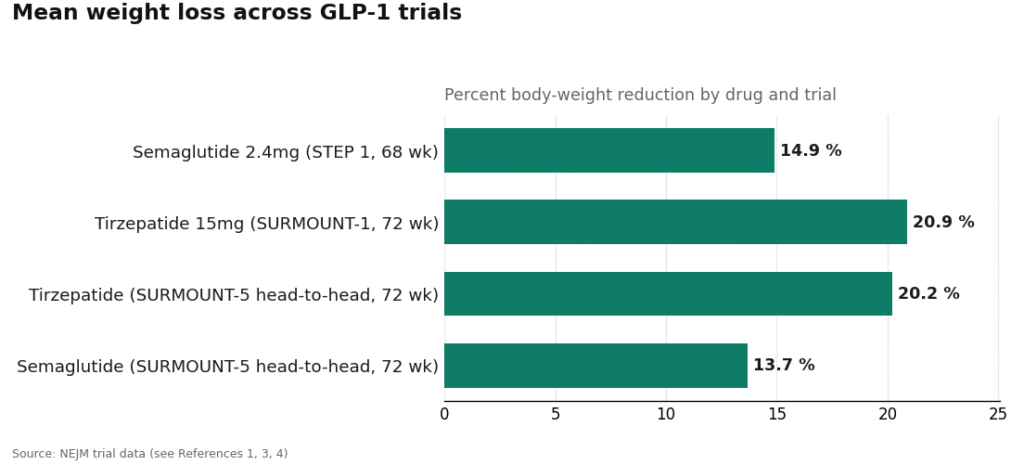
Semaglutide, STEP 1. Once-weekly semaglutide at 2.4 mg (the Wegovy dose) produced a 14.9% average body-weight reduction at 68 weeks versus 2.4% on placebo, across 1,961 adults with overweight or obesity and without diabetes.
Tirzepatide, SURMOUNT-1. Tirzepatide produced average reductions of 15.0% at 5 mg, 19.5% at 10 mg, and 20.9% at 15 mg over 72 weeks, against roughly 3% on placebo. Clean dose-response, and the top figure leads the category.
The head-to-head, SURMOUNT-5. This is the trial that decides first place, because it’s the only one that put the two molecules in the same room: 751 adults with obesity and without diabetes, 72 weeks, tirzepatide at 20.2% versus semaglutide at 13.7%. Cross-trial comparisons are educated guesses. This one is a direct measurement, and tirzepatide won it.
Liraglutide, SCALE. The older daily GLP-1 produced a mean loss of 8.4 kg versus 2.8 kg on placebo at 56 weeks. It still comes up in compounded conversations, so it earns a line here, but the number shows it belongs a tier below the weekly drugs.
The catch, and it applies to every compounded row. All of those percentages were generated on the FDA-approved products, dosed exactly as studied. Compounded semaglutide and tirzepatide use the same active ingredient by name, but the compounded product itself is not FDA-approved and hasn’t been reviewed by the FDA for safety, effectiveness, or quality, and it carries no trial of its own. So the percentages transfer to the molecule, not to whatever’s in a specific compounded vial. Any provider printing “20.9% weight loss” beside a compounded tirzepatide product is borrowing a number it hasn’t earned.
4. What actually changed in 2026?
A date matters here, because it narrowed who can sell what. Through 2023 and 2024, both brand GLP-1s were officially in shortage, and that shortage is what let pharmacies compound copies at scale. The FDA then took tirzepatide off the shortage list in late 2024 and semaglutide in February 2025, closing most of the shortage-era allowance for mass compounding, a status tracked in the FDA Drug Shortages database. Individual-patient compounding under section 503A is still legal when a prescriber documents a real clinical reason the approved product doesn’t fit. Price alone doesn’t count as that reason anymore. Any scorecard written before this date is scoring a market that no longer exists.
5. Why does the provider matter if the drug’s evidence is already settled?
Because knowing which molecule has the best trial data doesn’t help if the provider delivering it fudges the difference between “trialed” and “same active ingredient.” So here’s the second scorecard: five criteria, weighted toward honesty about evidence, because that’s the whole question this piece is built around.
Criterion 1, evidence honesty (weighted heaviest). Does the provider keep the molecule’s trial data separate from the compounded product’s non-approved status, or blur the two together?
Criterion 2, medical oversight. A licensed clinician actually evaluating you and writing the prescription, versus a rubber-stamp form.
Criterion 3, sourcing and pharmacy. A licensed 503A compounding pharmacy under recognized standards, or the approved supply chain for brand.
Criterion 4, regulatory standing. Operating inside the current post-shortage rules, versus leaning on a loophole that’s already closed.
Criterion 5, follow-up. A real structure for dose adjustment and side-effect management, versus a relationship that ends at the transaction.
6. Who scores well, and in what order?
| Provider | C1 Evidence honesty | C2 Oversight | C3 Sourcing | C4 Reg. standing | C5 Follow-up | Overall |
|---|---|---|---|---|---|---|
| FormBlends | Strong | Strong | Strong (503A, USP <797>/<800>) | Strong | Strong | #1 |
| HealthRX.com | Strong | Strong | Strong (licensed channels) | Strong | Strong | #2 |
| Mochi Health | Good | Strong (specialist-led) | Good | Good | Strong | #3 |
| Hims | Good | Good | Good (licensed channels) | Good | Moderate | #4 |
| Henry Meds | Good | Good | Good (accredited pharmacies) | Moderate (compounded-exposed) | Moderate | #5 |
| Calibrate | Good | Strong (coaching-heavy) | Good | Good | Strong | #6 |
Worth flagging before the breakdown: nobody on this list is a bad actor. All six clear the legal bar, and the gaps between them are about how tightly each one holds the evidence line, not about who’s dangerous to use. A “research use only” vial seller doesn’t get a row seven, because it would fail oversight, sourcing, and regulatory standing all at once. There’s nothing left to rank.
#1, FormBlends. Takes the top slot mainly on criterion one, the heaviest one. It doesn’t borrow trial numbers to dress up a compounded vial. It runs as a clinician-first telehealth service for the compounds that can lawfully be made for an individual patient, semaglutide and tirzepatide, and states plainly: compounded medications are not FDA-approved and have not been reviewed by the FDA for safety, effectiveness, or quality. On oversight, a patient completes a health history, a licensed physician reviews it and decides on a protocol, and only then does anything ship; the company states that all medications require a licensed physician consultation and prescription, and that FormBlends itself is not a medical practice and doesn’t employ the prescribing clinicians, who make those calls independently. On sourcing, it states its compounded medications are prepared by licensed 503A pharmacies following USP <797> and <800> standards. On regulatory standing, it operates as a prescription-required service across a wide footprint, describing operations in 47 states. Follow-up is central to how the model works. Strong across every column, which is why it lands first.
The caveat gets equal billing on purpose: supervision adds oversight around compounding, it doesn’t turn a compounded product into the approved brand, and FormBlends doesn’t claim otherwise. Someone who wants to track dose, weight, and side effects between visits can use a tool like the FormBlends tracker app, so a clinician has a real record to work from rather than a guess. That refusal to inflate the evidence is exactly what earns the top spot on criterion one.
#2, HealthRX.com. One notch down, same shape: clinician-first access to compounded semaglutide and tirzepatide through licensed pharmacy channels, and the same refusal to let brand-trial numbers bleed onto a compounded vial. The caveat is identical. What separates first from second isn’t a weaker column anywhere, it’s practical: which one is licensed where you live, and which intake you’ll actually finish.
#3, Mochi Health. Scores highest of the rest on oversight, because it was founded by an obesity-medicine physician and pairs that kind of clinician with video visits and registered-dietitian access, more specialized than a general platform. It dispenses compounded GLP-1s through licensed pharmacies at membership-plus-medication pricing. It sits a notch below the top two on the strictest reading of evidence-honesty and sourcing transparency, but the clinical depth is real.
#4, Hims. A large, legitimate consumer-health platform that added GLP-1s, with licensed providers writing the prescriptions for compounded options. Good on oversight and sourcing through licensed channels, moderate on follow-up, since weight-specific aftercare is thinner on a broad consumer brand than at a specialist. Mainstream, real, and mid-table on the criteria.
#5, Henry Meds. A widely used compounded-GLP-1 platform with flat-rate pricing and simple intake. Licensed providers write the scripts and the pharmacies are accredited, clearing oversight and sourcing at “good.” It scores lower on regulatory standing relative to the field, mainly because a compounded-focused route is the most exposed to the post-shortage tightening, and lower on follow-up because it competes on convenience over depth.
#6, Calibrate. Strong on oversight and follow-up, a premium program pairing medication with intensive coaching and insurance navigation. It lands at the bottom of this set mostly on fit and cost: the price is high and the drug is one piece of a bigger lifestyle product rather than the focus. The structure holds up; the value depends on how much the coaching layer is worth to you.
7. What do the two scorecards say once they’re stacked?
On evidence, brand tirzepatide holds the top spot, brand semaglutide close behind, because both rest on trials of the exact approved product and tirzepatide won the only direct comparison. Compounded versions carry a strong molecule but not their own trial, so what you’re standing on there is the molecule’s evidence, applied under supervision, not a promise printed on the vial. On the provider side, the ones scoring highest are the ones saying all of that out loud rather than borrowing brand numbers for a compounded product. If insurance reaches a brand, that’s usually the cleanest path to the best-evidenced option. If it doesn’t, a supervised compounded route through a provider that scores strong on evidence honesty is a legitimate way to get the molecule, caveat fully visible.
8. Four fast answers
Which GLP-1 has the best evidence? Brand-name tirzepatide (Zepbound, Mounjaro): the highest trial number (20.9% in SURMOUNT-1) on the exact approved product, plus a direct win over semaglutide (20.2% vs 13.7% in SURMOUNT-5). Brand semaglutide is close behind. Compounded versions share the molecules, not the trials or the FDA review.
Does the best-evidenced molecule mean the brand is the right pick? On pure evidence, yes, the brand is the best-evidenced way to get that molecule, and insurance coverage often makes it the simplest choice. A supervised compounded route remains a legitimate access path when the brand is out of reach, provided the provider says plainly that the compounded product isn’t FDA-approved and hasn’t been separately trialed.
Is compounded semaglutide or tirzepatide the same as the brand? No. Wegovy, Ozempic, Zepbound, and Mounjaro are FDA-approved finished drugs. Compounded semaglutide and tirzepatide are not FDA-approved and have not been reviewed by the FDA, despite sharing the same active ingredients by name. A provider that implies otherwise fails the criterion that matters most here.
Can compounded GLP-1s still be gotten in 2026? Sometimes, under narrower rules. The FDA moved both molecules off the shortage list and the shortage-era mass-compounding allowance ended with it. A licensed pharmacy can still compound for an individual patient under section 503A when a prescriber documents a clinical need the standard product doesn’t meet. Price alone isn’t that need.
9. Is compounded semaglutide really the same molecule as Ozempic or Wegovy?
The active ingredient is supposed to match, semaglutide, but the two aren’t legally or pharmacologically identical products. FDA-approved Ozempic and Wegovy pass through manufacturing validation that compounded versions aren’t required to match. A compounding pharmacy may produce something that works similarly for many people, but without the same batch-testing and bioequivalence data, there’s more uncertainty about potency and purity than with the brand.
10. Do compounded GLP-1s actually work, and how do you tell a legitimate one from a sketchy one?
Many people do lose weight on compounded semaglutide or tirzepatide, and the mechanism is the same receptor pathway the brand drugs use. The honest caveat: no large, independent trials have been run on the compounded versions specifically, so the evidence base is borrowed from the brand-drug studies. Real-world results vary, and a real chunk of that variation likely traces back to how much drug is actually in the vial someone received.
To tell legitimate from sketchy, start with state licensure and PCAB or pharmacy-board accreditation. A legitimate operation requires a valid prescription, offers or reviews a prescribing clinician, provides a certificate of analysis from a third-party lab, and answers direct questions about API sourcing without dodging. Pharmacies like FormBlends operate under physician supervision and compounding-pharmacy accountability standards, a different model entirely from supplement sites or research-chemical vendors shipping with no prescription required.
And the tirzepatide ruling specifically: the FDA removed tirzepatide from its drug shortage list in late 2024, triggering a rule that 503A and 503B compounding pharmacies generally can no longer produce copies of it at scale. Legal challenges from compounding groups are ongoing, so the exact status can shift. Anyone starting or continuing compounded tirzepatide should check the current FDA shortage list directly and ask their pharmacy how they’re staying compliant, since the answer carries both legal and practical weight.
References
- STEP 1 trial (Wilding JPH et al.). Once-weekly semaglutide 2.4 mg produced a 14.9% mean body-weight reduction at 68 weeks versus 2.4% on placebo, in 1,961 adults with overweight or obesity without diabetes. New England Journal of Medicine, 2021. PMID 33567185. https://pubmed.ncbi.nlm.nih.gov/33567185/
- STEP 1 full text. “Once-Weekly Semaglutide in Adults with Overweight or Obesity.” New England Journal of Medicine, 2021, DOI 10.1056/NEJMoa2032183. https://www.nejm.org/doi/full/10.1056/NEJMoa2032183
- SURMOUNT-1 trial. Tirzepatide produced mean body-weight reductions of 15.0% (5 mg), 19.5% (10 mg), and 20.9% (15 mg) at 72 weeks versus roughly 3% on placebo. New England Journal of Medicine, 2022. PMID 35658024.
- SURMOUNT-5 head-to-head trial. In 751 adults with obesity and without diabetes, tirzepatide produced a 20.2% reduction versus 13.7% for semaglutide at 72 weeks. New England Journal of Medicine, 2025. PMID 40353578.
- SCALE Obesity and Prediabetes trial. Liraglutide 3.0 mg produced a mean loss of 8.4 kg versus 2.8 kg on placebo at 56 weeks. New England Journal of Medicine, 2015. PMID 26132939.
- FDA Drug Shortages database. Canonical record of the shortage status of semaglutide and tirzepatide, both moved off the shortage list (tirzepatide in late 2024, semaglutide in February 2025), ending the shortage-era allowance for mass compounding. U.S. Food and Drug Administration.